

Podcast Recap:
In this conversation, Madeleine shares golden nuggets of parenting wisdom collected from EPIC's Youth Mental Health First Aid trainings and Online Meet Ups. Drawing on the lived experience of parents and carers, she explores the power of curiosity, listening, connection over control, self compassion and holding on to hope. Simple reminders that can make a big difference when supporting a young person through challenging times.
Host: Madeleine Steel - EPIC CEO
Podcast Transcript:
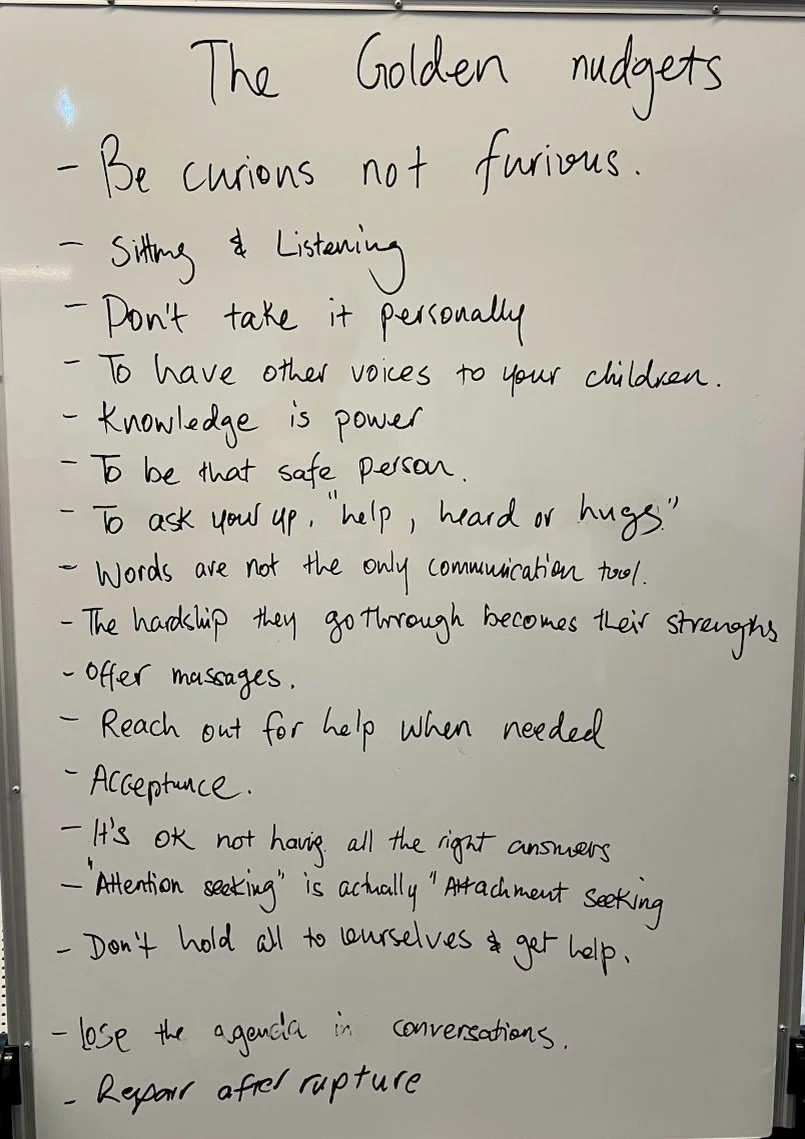
Parent Wisdom from the recent Youth Mental Health First Aid training
-
Hello and welcome to EPIC Conversations. I'm Mads from Empowering Parents In Crisis, or EPIC.
I'm recording on Darramuragal land, and I pay my respects to Elders past and present. Thank you to Lane Cove Council for supporting our EPIC Online Meet Ups and this podcast series.
Today, I want to share something with you that I absolutely love. It's something we call the Parent Well of Wisdom.
Now, I want you to imagine a room full of parents and carers, all coming together to learn about youth mental health. At the front of the room is a big, empty whiteboard, and I ask everyone a question.
What's the best piece of parenting advice you've ever been given? Or perhaps something you've learned the hard way?
I always start with my own favourite. Be curious, not furious.
And then something wonderful happens. The board starts filling up. Sometimes it's three words. Sometimes a whole sentence. Sometimes someone shares something that makes everyone in the room nod. And before long, that empty whiteboard is overflowing with wisdom.
Wisdom that hasn't necessarily come from books or professionals. It's come from parents. From lived experience. From loving and supporting young people through some really challenging times.
And what I love is that no two boards are ever quite the same. There's always something new to learn.
At our recent EPIC Online Meet Up, we decided to dive into these golden nuggets and share some more. One parent made a really interesting observation. They said the beauty of these nuggets is their simplicity. A few words are easy to remember when we need them most.
And isn't that true? When things are going pear-shaped at home, when emotions are running high, or when we're lying awake at three in the morning worrying about our young person, we're probably not going to remember everything we've read in a parenting book.
But we might remember four little words. Be curious, not furious. Or perhaps, this too shall pass.
In our last podcast, we explored what peer parent support is and why connecting with other parents who understand can be so powerful. Well, today we're going to explore what happens when parents share the wisdom they've gathered along the way.
Because one of the things I've learned through EPIC is that parents know an extraordinary amount. Sometimes we just need to be reminded of it.
And perhaps, by the end of this episode, you'll have a golden nugget or two to carry with you.
-
Let's start with my favourite. Be curious, not furious.
Now, I wish I could tell you I always get this right! But the reality is, when we're worried about our young people, curiosity isn't always our first reaction. Fear often gets there first.
Imagine your young person has told you they've been going to school, and then you discover they haven't been attending. You might feel angry, frustrated, frightened or betrayed. And the first thing that comes out of your mouth might be, "Why have you been lying to me?"
Which is understandable. But what happens if we pause and approach things with curiosity instead? "Help me understand what's been happening." Or, "What's been making school so hard lately?"
It's a very different conversation, isn't it? We're not saying the behaviour doesn't matter. We're simply trying to understand what's underneath it.
And that brings us to another wonderful nugget. See the person, not the behaviour.
Sometimes the behaviour we're seeing is just the tip of the iceberg. Underneath might be anxiety, shame, fear, overwhelm, sadness or something we haven't even considered. When we become curious, we create an opportunity to understand.
And that doesn't mean we have to agree with everything our young person says or does. It simply means we're willing to listen.
Which brings me to another golden nugget. The power of the pause.
Oh, this is a good one. How often do we jump straight in when our young person tells us something? We want to help. We want to fix it. We want to make things better.
I think most parents could qualify for an Olympic medal in problem solving! Our young person tells us something, and before they've finished the sentence, we've already come up with three solutions, a backup plan and possibly a spreadsheet.
But sometimes, that's not what they need. Sometimes they just need us to listen.
There's a very funny little video called It's Not About the Nail, which one of our parents recommended. It's about the difference between listening and trying to fix things. If you haven't seen it, I'll put the link in the resources below. It's worth watching, because I think most of us will recognise ourselves!
Another parent shared this beautiful question: Do you want to be helped, heard or hugged?
I love that. Because sometimes our young person doesn't want advice. They might just want to tell us about their day, have a good whinge, or sit beside us without saying very much at all.
And if we don't know what they need, we can ask. "Would you like me to listen, or would you like some ideas?" It takes the guesswork out of it, and it gives our young person some choice.
Of course, sometimes they don't want to talk at all. And that's OK too.
Another nugget reminds us that words are not the only way we communicate.
Sometimes connection happens in the car, walking the dog, making dinner, or just sitting quietly together. And communication doesn't always have to happen face to face either.
It might be a quick text message, an emoji, a funny meme, or a little note left on the kitchen bench.
At one of our EPIC gatherings, a parent shared something that made me smile. She sends her young people funny memes and videos. Crazy cats, silly animals, all sorts of things!
Firstly, it's a lovely way to connect. Something lighthearted they can share without needing to have a conversation. But she also hopes that by sharing more funny, positive content, she might influence what the social media algorithms show them.
Now, I don't know how much difference that makes to the algorithms, but I love the thinking behind it! And who doesn't need a funny cat video every now and then?
It got me thinking. How does your young person like to communicate?
Do they prefer texting? Sending funny videos? Using emojis? Perhaps they find it easier to share something difficult in a message rather than saying it out loud.
What if we asked them? "What's the easiest way for us to communicate when things are tricky?"
We could even agree on little signals together. Perhaps a particular emoji means "I'm having a hard day" or "I need some space", without having to explain everything.
I love the idea of co-designing communication with our young people. Finding ways to connect that work for both of us, rather than expecting them to communicate the way we do.
Because connection doesn't always need a conversation. Sometimes a message, a shared laugh, or simply being there is enough.
-
Now, this next theme is one that I think is particularly important for parents supporting young people through mental health challenges or risky behaviours.
Connection over control.
As parents, we spend years keeping our children safe. When they're little, we can hold their hands crossing the road, make sure they eat their vegetables, and tell them when it's bedtime. Well, we can try!
But as our children grow into teenagers and young adults, things change. We can't control every decision they make. And that can be incredibly frightening, particularly when we're worried about their safety.
We might be dealing with school refusal, substance use, self-harm, unhealthy relationships or other behaviours that keep us awake at night. And our natural instinct is to try harder. To ask more questions. To monitor more closely. To persuade, negotiate, remind and sometimes lecture.
Because we love them. And because we're scared.
But here's one of the nuggets that I think can change the way we approach things. From control to influence.
We may not be able to control every choice our young person makes. But we can work on being someone they trust. Someone they feel safe coming to. Someone who will listen without immediately judging or reacting. And that relationship gives us influence.
Now, I want to be clear about something. Connection over control doesn't mean abandoning boundaries or ignoring dangerous behaviour. Sometimes we absolutely need to step in, seek professional help or take action to keep someone safe.
But in those everyday moments when we're trying to maintain a relationship with a young person who is pulling away, connection can be incredibly powerful.
Another nugget from our boards is: They push you away, yet they want you there.
Oh, how many parents can relate to that one? One minute we're being told to go away, leave them alone, stop asking questions. And then perhaps an hour later, they're sitting beside us on the couch, wanting something to eat, or telling us about something that happened during their day.
It can feel like emotional whiplash! But sometimes our young people need space and connection at the same time. And learning to navigate that isn't always easy.
Another nugget says: Attention seeking is attachment seeking.
I love this one because sometimes we hear the words "attention seeking" used in such a negative way. But here's a question. Who needs attention?
We all do! We all need to feel seen, heard, valued and connected to others.
And sometimes our young people might seek that attention in ways that are difficult for us to understand, or that aren't particularly helpful or healthy.
Rather than dismissing the behaviour as attention seeking, what if we asked ourselves, "What is my young person trying to tell me? What might they need right now?"
Perhaps they need more connection, reassurance or support. Perhaps they need our help to find healthier ways to express what they're feeling or ask for what they need.
Because needing attention isn't a bad thing. It's part of being human. And sometimes the young people who are finding it hardest to ask for support are the ones who need it most.
And then there's one of my absolute favourites. Repair after rupture.
Because here's the thing. We're not perfect parents. We're human. We get tired. We get frightened. We lose our patience. Sometimes we say things we wish we hadn't. And sometimes our young people do too.
Relationships have ruptures. But what's important is that we can repair them.
Imagine you've had an argument with your young person. Voices have been raised. Things have been said. Everyone's upset.
Later, when things have settled, you might say, "I'm sorry I got angry earlier. I was worried about you, but I didn't handle that very well."
Or simply, "That didn't go the way I wanted. Can we start again?"
What a powerful message that sends. It shows our young people that relationships can survive difficult moments. That we can take responsibility for our own behaviour. And that it's OK to make mistakes and try again.
One of the resources shared at our Online Meet Up was a short video about co-regulation and how young people gradually move from dependence towards independence.
The idea is that, over time, young people develop their own ability to manage emotions, with support from the people around them.
And while we can't always be calm, our ability to manage our own responses can make a real difference.
Which leads us beautifully into our next theme.
-
Now, can we talk about us for a moment? The parents and carers.
Because when our young person is struggling, it's very easy for our whole world to revolve around them.
Are they safe? Have they eaten? Are they sleeping? Have they gone to school? Are they taking their medication? Have they responded to our messages?
And somewhere in amongst all of that, we can forget about ourselves.
One of the most common nuggets on our boards is: Put your own oxygen mask on first.
We've all heard it. But how many of us actually do it?
When you're supporting a young person through a mental health crisis, looking after yourself can feel almost impossible. You might feel guilty going for a walk, catching up with a friend, or doing something you enjoy.
Because how can you possibly relax when your young person is struggling?
But here's another nugget. You can only give what you've got.
And I think that's worth remembering. We're not machines. We can't keep pouring from an empty cup.
Sometimes caring for ourselves means something as simple as getting outside, having a cuppa with a friend, spending time in the garden, or taking a few minutes to breathe. Sometimes it means asking someone else for help. And sometimes it means finding a group of people who understand what we're going through.
At our Online Meet Up, one parent shared something I thought was really important. Find a group where you can talk about your own feelings.
Not just what's happening with your young person. But how you're feeling.
Because our feelings matter too. We might be frightened, exhausted, frustrated, grieving, lonely or overwhelmed. And having somewhere safe to share those feelings, without fear of judgement, can be such a relief. Like letting the pressure out of a pressure cooker.
That's one of the things I love most about EPIC. When parents come together, there's often this enormous sense of relief. That feeling of, "Oh, thank goodness. Someone gets it."
You don't have to explain everything. You don't have to pretend things are fine. You can just be yourself.
And sometimes, another parent saying, "You're doing a great job," is exactly what we need to hear.
Another nugget that came up at our meet up was: Recognise the small wins.
I love this one. Because when we're supporting a young person through difficult times, progress doesn't always look the way we expected.
A small win might be your young person coming out of their bedroom and joining you for dinner. It might be a conversation that doesn't end in an argument. It might be them agreeing to go for a short walk.
Or perhaps it's you managing to pause rather than react when something difficult happens.
These things matter. And sometimes, when we're focused on everything that's going wrong, we forget to notice what's going right.
Another parent shared that we all need four things in our lives. Something to do. Someone to love. Something to look forward to. And something to give back.
I think that's a lovely reminder that our lives need to contain more than the challenges we're navigating.
And finally, two nuggets that belong together. Self compassion. And It's OK not to be perfect.
We can be incredibly hard on ourselves as parents. We replay conversations. We question our decisions. We wonder what we could have done differently.
But what if we spoke to ourselves with the same kindness we'd offer another parent? What if we reminded ourselves that we're doing the best we can with what we know and what we have available to us?
I took parenting very seriously. It was my number one priority.
But I had a lot of plates spinning, and when one started to wobble, they all seemed to wobble. For a while, it felt like plates were smashing all around me.
I realised I needed to look after myself too. And connecting with other parents who understood what I was going through helped me find some peace of mind and regain my confidence.
And here's something I'd love you to remember. Looking after yourself isn't taking something away from your young person. It's helping you remain well enough to keep supporting them.
-
Our final theme is about something that can be incredibly difficult. Letting go. And holding on to hope.
One of the nuggets that came up at our Online Meet Up was: It's a marathon, not a sprint.
And isn't that true? When our young person is struggling, we desperately want things to get better. Preferably yesterday!
We want to find the right professional, the right strategy, the right conversation, the right answer. And sometimes we expect progress to happen in a straight line.
But it rarely does. There can be good days and difficult days. Two steps forward and one step back. Sometimes three steps back! And that can be exhausting.
Which is why I love this next nugget. Everything changes.
However hard today might be, tomorrow or next week could look different. That doesn't mean everything will suddenly be OK. But it reminds us that what we're experiencing right now isn't necessarily what life will look like forever.
Another parent shared: I can't control the waves, but I'm learning to ride them.
What a beautiful image. Because sometimes it really does feel like we're being tossed around by waves. Just when things seem to be settling, another one comes along.
And perhaps part of our journey as parents is learning how to navigate those waves without being completely overwhelmed by them.
Which brings me to another nugget. Be the lighthouse. Or the life raft.
I love this one. A lighthouse doesn't chase boats around the ocean. It stays steady. It offers light and direction.
And sometimes, that's what our young people need from us. Not someone chasing them with answers or trying to steer every decision. But someone they know is there. Someone they can find their way back to.
And at other times, they might need a life raft. Someone to help them stay afloat when things become overwhelming.
Of course, there are times when our young people need more than we can provide ourselves, and that's when reaching out for professional support is so important.
But I think the lighthouse is a beautiful reminder of the role we can play.
Another nugget from the boards is: This is not mine to control.
Now, that can be a very hard thing for a parent to say. Because when we love someone, particularly when we're frightened for their wellbeing, letting go of control can feel like giving up.
But there's a difference between giving up and recognising what is, and isn't, within our control.
We can offer support. We can listen. We can encourage. We can set boundaries. We can seek help when safety is at risk. But we can't live our young person's life for them.
And learning to recognise that can be both painful and freeing.
At our meet up, someone shared a nugget that has really stayed with me.
Ask yourself what you're doing from love and what you're doing from fear. Do more from love.
I think this is incredibly powerful. Because so much of what we do as parents comes from love. But sometimes, that love gets tangled up with fear.
We ask the same question ten times because we're worried. We push for answers because we're frightened. We try to control situations because we desperately want our young person to be safe.
And sometimes, when fear takes over, we respond in ways that actually make connection harder.
So perhaps it's worth asking ourselves: Am I responding from love right now, or is fear driving this conversation?
And if fear is taking over, what might a response grounded in love look like?
It might mean pausing. It might mean listening. It might mean giving our young person a little space. Or it might mean calmly stepping in because there's a genuine safety concern.
Love doesn't always mean stepping back. Sometimes love means taking difficult action. But I think the nugget invites us to be more thoughtful about how we respond.
I remember times when I felt there was absolutely nothing I could do to help my young person. And that feeling of helplessness was incredibly hard.
So I started picturing them safe, healthy and strong, and in my mind, sending them love and protection.
It was a little thing, but it helped me shift my focus from fear to love. And even when there was nothing I could physically do, it helped me feel connected to them, and that I was still doing something to support them.
And finally, one of the nuggets that I think every parent deserves to hear. Trust yourself.
Your intuition. Your gut. Your wisdom.
Now, that doesn't mean we always know the answers. Or that we shouldn't seek professional advice.
But it does mean recognising that we know our young people in ways that others may not. We know their history. We know their strengths. We often notice subtle changes that someone else might miss.
And our knowledge and observations matter. We are an important part of the circle of support around our young people.
So please don't underestimate the wisdom you already carry.
-
Before we finish, I want to come back to that whiteboard. The one that starts empty at the beginning of every Youth Mental Health First Aid training. And by the end of our icebreaker, it's full of golden nuggets.
Every time I look at those boards, I'm reminded of something really important. Parents have so much wisdom to share.
Not because we've done everything perfectly. Not because we've always known what to do. But because we've learned along the way.
We've made mistakes. We've tried things that haven't worked. We've discovered things that have helped. And we've kept going, even when it's been really hard.
And when we share those experiences with each other, something wonderful happens. Our individual experiences become collective wisdom.
That's what peer parent support is all about. And it's why I believe so strongly that parents and carers deserve to be recognised as part of the solution in youth mental health.
Because parents are often the first responders when their young person is struggling. And they have so much to contribute.
But before I go, I'd love to leave you with a little invitation.
What's your golden nugget?
Maybe it's something someone once said to you that changed the way you parent. Maybe it's something you've learned through your own experiences. Or perhaps you've heard something today that you'd like to carry with you.
You might choose: Be curious, not furious. The power of the pause. Connection over control. Repair after rupture. Recognise the small wins. Or perhaps, do more from love.
Whatever it is, I'd love you to share it with us.
Because the beautiful thing about our Parent Well of Wisdom is that it never stops growing. And you never know when something you've learned might be exactly what another parent needs to hear.
If you're not already part of the EPIC community, I'd love you to join us. We have our EPIC Walks, Online Meet Ups, creative gatherings and WhatsApp communities, where parents can connect with others who understand.
You can find everything on our website at empoweringparentsincrisis.com.
And if you believe, as we do, that parents and carers should be recognised and supported as part of the youth mental health system, we'd love you to be part of our Back Parents. Back Youth Mental Health campaign.
I'll include all the links, along with the resources parents recommended, in the show notes.
If you're worried about your own wellbeing or your young person's safety, please reach out for appropriate support. You don't have to manage everything alone. Lifeline is available on 13 11 14, and Kids Helpline is on 1800 55 1800 for young people aged 5 to 25. If someone is in immediate danger, call 000.
A big thank you to Lane Cove Council for supporting our EPIC Online Meet Ups and this podcast series.
And thank you to every parent who has contributed to our growing well of wisdom.
Your experiences matter. Your knowledge matters. And your wisdom might just be the thing that helps another parent through a difficult day.
Thanks for listening. Take care of yourself, and I'll talk with you next time.
The Parent Well of Wisdom
A collection of golden nuggets shared by parents and carers at EPIC's Youth Mental Health First Aid trainings and Online Meet Ups.
These simple reminders come from lived experience. They're not rules or perfect solutions, just little pieces of wisdom that might help us navigate the challenges of supporting our young people.
Take what resonates, leave what doesn't, and remember you're not alone.
Curiosity and Listening
Be curious, not furious
Tell me more about that
The power of the pause
Don't jump in with solutions
Do you want to be helped, heard or hugged?
Words are not the only way we communicate
Connection doesn't always need a conversation
When your young person comes to you, ask whether they want to vent, get advice or simply offload
Connection Over Control
See the person, not the behaviour
From control to influence
Attention seeking is attachment seeking
They push you away, yet they want you there
Repair after rupture
Be the lighthouse or life raft
Filling Your Own Tank
Put your oxygen mask on first
Self compassion
It's OK not to be perfect
You can only give what you've got
Recognise the small wins
Find a group where you can talk about your own feelings
Words of encouragement matter. You're doing a great job!
We all need four things: something to do, someone to love, something to look forward to, and something to give back
Letting Go and Holding On to Hope
This is not mine to control
Pick your battles
This too shall pass
Even in the dark there is light
Everything changes. However hard today is, tomorrow or next week could look different
It's a marathon, not a sprint
I can't control the waves, but I'm learning to ride them
Acceptance
Trust yourself. Your intuition, your gut, your wisdom
Ask yourself what you're doing from love and what you're doing from fear. Do more from love
You're not alone
Helpful Resources Recommended by EPIC Parents during the online meet up:
A collection of films, videos, books and resources shared by parents and carers in our EPIC community.
Seen — The Film A powerful film exploring the impact of childhood experiences and the importance of connection in parenting.
It's Not About the Nail — A Short Video A funny reminder that sometimes people need us to listen rather than jump in with solutions.
From Dependence to Independence — Co-regulation A short video exploring how young people develop emotional regulation and independence through connection and support.
Untangled — Dr Lisa Damour A book helping parents better understand the emotional and developmental changes of adolescence.
headspace — Partners in Parenting A free online parenting program offering practical strategies to support young people's mental health and wellbeing.
EPIC Parent Support Resources Explore more helpful resources, information and support for parents and carers navigating youth mental health challenges.
What's Your Golden Nugget?
The Parent Well of Wisdom keeps growing, thanks to parents and carers sharing what they've learned along the way.
Perhaps it's something someone once said to you, or something you've discovered through your own parenting journey.
We'd love you to share your wisdom with the EPIC community.
Because sometimes a few simple words can make an enormous difference to another parent.
Keep Connecting With EPIC
If this conversation resonated with you, we'd love you to stay connected.
EPIC Walks — Walk, talk and connect with parents who understand.
EPIC Online Meet Ups — Share experiences, ideas and wisdom in a safe, non-judgmental space.
Join the EPIC Community — Connect through our WhatsApp groups and monthly newsletter.
Back Parents. Back Youth Mental Health — Help us advocate for parents and carers to be recognised and supported as part of the youth mental health system.
Thank you to Lane Cove Council for supporting the EPIC Online Meet Up series.
Do you have suggestions, comments, questions relating to today’s conversation or have ideas for future episodes? We would love to hear from you. Send EPIC an email here.
If this conversation has raised concerns for you or your young person, support is available any time.
Lifeline 13 11 14. Kids Helpline 1800 55 1800. In an emergency, call 000.
This podcast was made possible by the support of Lane Cove Council.