Episode Fifteen: Stages of Change



Podcast Recap:
In this episode of EPIC Conversations, Madeleine introduces the Six Stages of Change and explores how this model can help parents better understand behaviour, readiness, and resistance to change.
With a focus on connection, safety, and trust, this episode offers practical insights for parents supporting young people through mental health challenges, risky behaviours, and moments of crisis — reminding us that change is not linear, and pushing too hard can often push change away.
Podcast Transcript:
Welcome to EPIC Conversations, a podcast where we bring parents practical tools and insights to support their young people.
This episode is being recorded on Durramurragal land, and I pay my respects to Elders past and present, and to any First Nations people listening.
My name is Madeleine, co‑founder of EPIC. Thank you for joining us.
Today I’m going to talk about a model called the Transtheoretical Model of Change, also known as the Six Stages of Change.
This model can be incredibly helpful for parents who are trying to understand why change feels slow, why pushing often backfires, and how to support a young person in a way that actually helps.
The Transtheoretical Model of Change was first developed in 1977 by psychologist James Prochaska at the University of Rhode Island.
It was originally created to understand what happens in the mind when someone is trying to give up smoking.
What researchers noticed was this:
People didn’t just wake up one day and quit.
Instead, they moved through predictable stages — often going forwards, backwards, and sideways — before lasting change occurred.
Since then, this model has been adapted for many areas, including:
fitness and physical activity campaigns
quitting alcohol and other substances
weight loss and lifestyle changes
mental health treatment
and even marketing
Marketing is a great example, because companies learn very quickly that messages only work when they match the stage someone is already in. Push too hard, too soon — and people resist.
And this is a key takeaway for parents too:
Change works best when we meet someone where they are, not where we wish they were.
WHY THIS MATTERS FOR EPIC PARENTS
Many of the behaviours we worry about — such as:
substance use
excessive gaming
school avoidance
self‑harm
risky or dangerous behaviour
not coming home
harmful dieting
social media addiction
These behaviours rarely disappear because someone tells a young person to “just stop.”
They change when:
safety increases
trust increases
understanding increases
and support matches the young person’s readiness to change
So let’s walk through the six stages of change, with a focus on what may be happening inside your young person — and what helps most from you as a parent.
STAGE 1: PRECONTEMPLATION
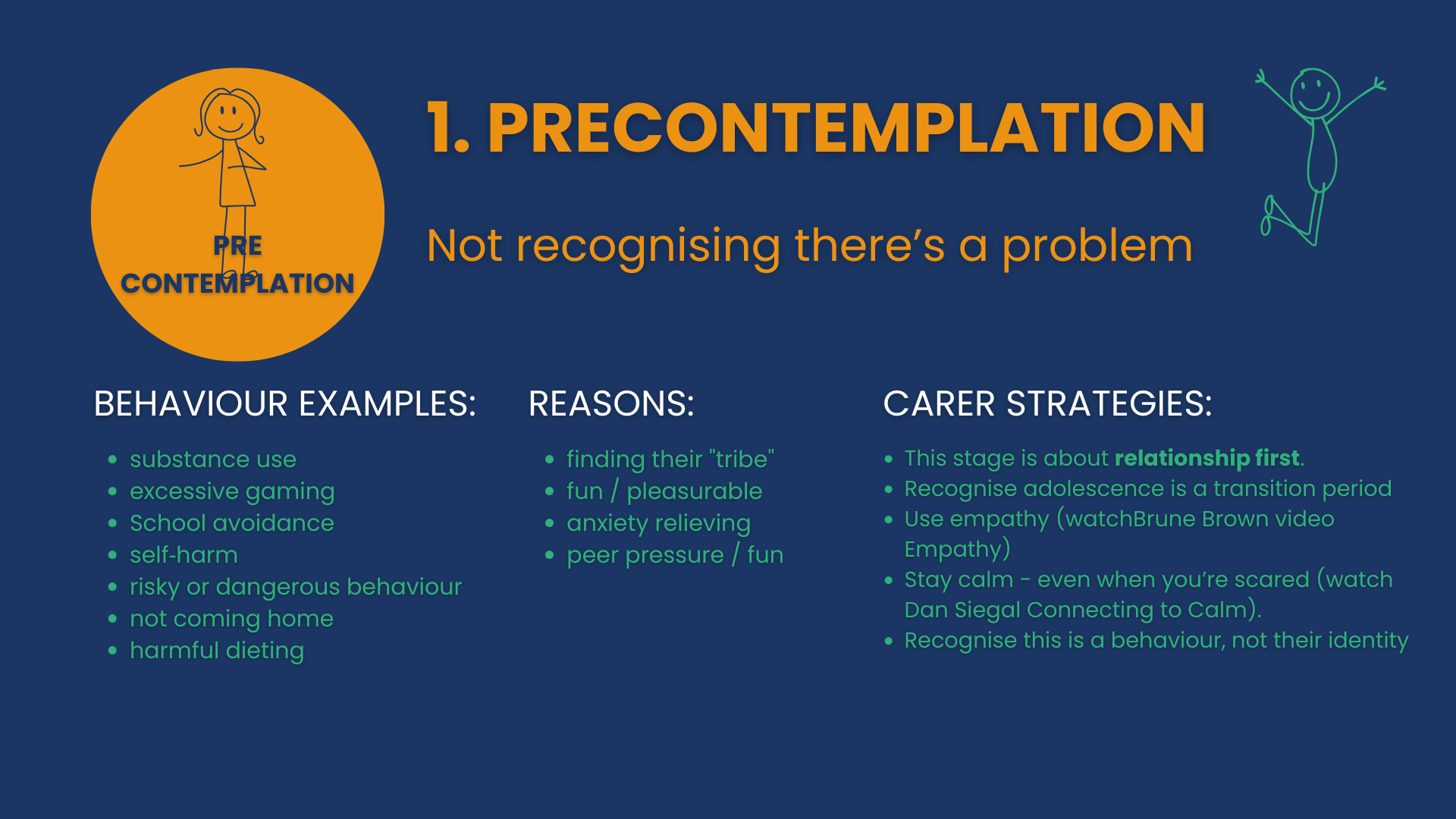
Precontemplation means not recognising that there is a problem.
From a parent’s perspective, this can be one of the most challenging stages.
Your young person might be:
gaming excessively
vaping
using drugs or alcohol
avoiding school
engaging in risky behaviour
From their point of view:
it might be fun
it might relieve anxiety
it might give them a sense of belonging
or it might simply meet a need
They are not being difficult — they are meeting a need with the tools they currently have.
In this stage, confrontation is usually unhelpful.
More effective carer strategies include:
recognising that your young person is transitioning from total dependence toward independence
connecting with empathy (Brené Brown has a great short video “Empathy”, watch here)
staying calm — even when you’re scared (Dan Siegel’s Connecting to Calm is also a helpful resource, watch here.)
remembering this is a behaviour, not their identity. For example they are vaping, not they are a vaper. Verb versus noun. A noun can become a label that defines identity while a verb defines an action.
This stage is about relationship first.
Because without connection, change doesn’t stick.
STAGE 2: CONTEMPLATION
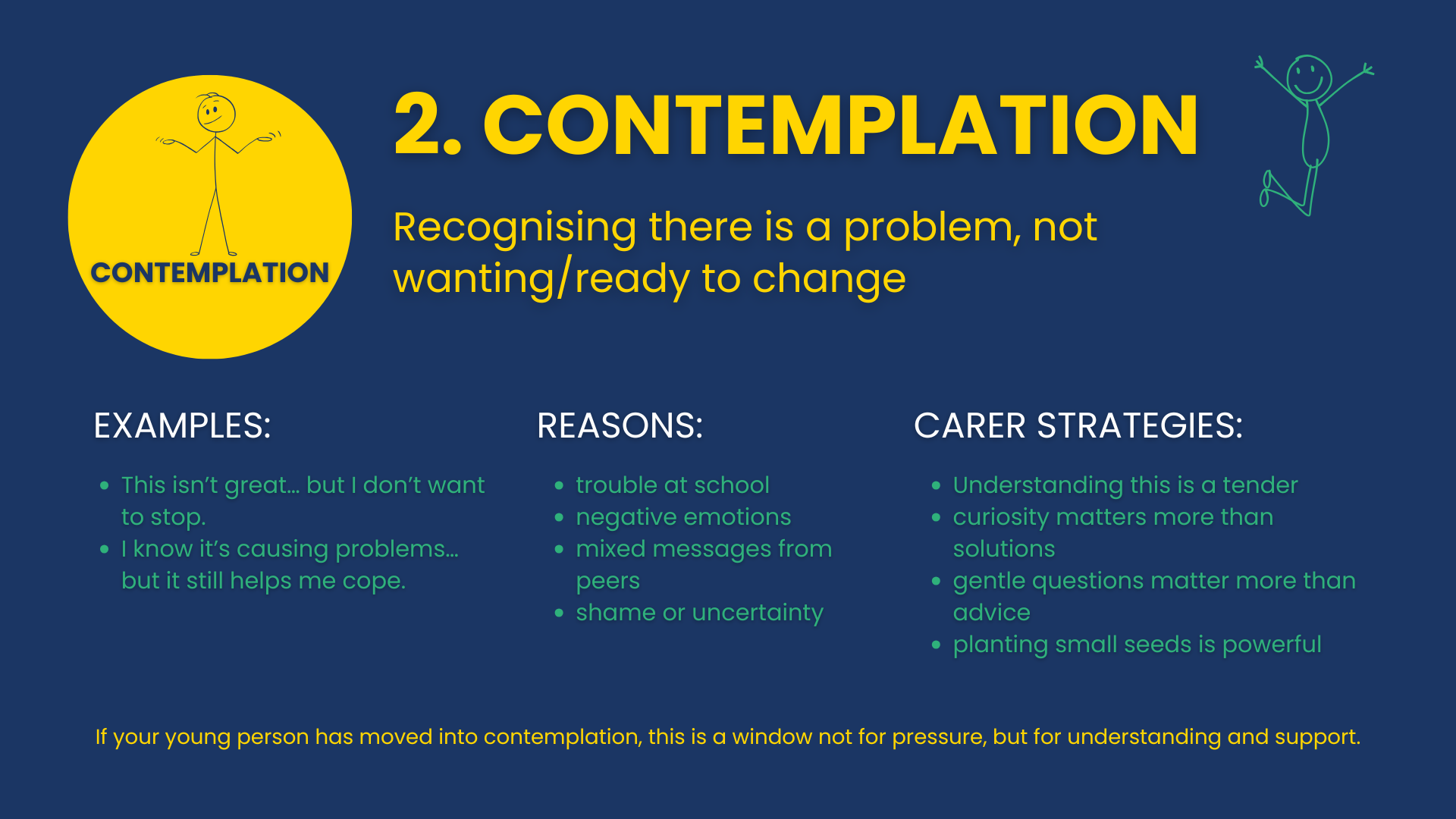
In the contemplation stage, your young person begins to recognise that there may be a problem — but they’re not ready to change yet.
They might think:
“This isn’t great… but I don’t want to stop.”
“I know it’s causing problems… but it still helps me cope.”
They may be experiencing:
difficulty at school
negative emotions
mixed messages from peers
shame or uncertainty
This is a tender stage.
For parents, this is where:
curiosity matters more than solutions
gentle questions matter more than advice
planting small seeds can be powerful
If your young person has moved into contemplation, this is a window — not for pressure, but for understanding and support.
STAGE 3: PREPARATION

Preparation is when your young person starts thinking, “I might actually do something about this.”
You might notice:
them gathering information
planning small changes
opening up more in conversation
taking tentative first steps
This stage requires a high level of trust.
Helpful carer strategies include:
asking how they want to be supported
creating a safe, non‑judgemental space
helping them think through a plan
supporting the development of a trusted support team
It can be helpful to think about levels of trust:
people your young person fully trusts
people they trust but don’t fully disclose everything to
and people who are involved on a need‑to‑know basis
A powerful question in this stage is:
“Do you want me to listen — or do you want advice?”
That one question can protect trust and empower your young person.
STAGE 4: ACTION

In the action stage, change becomes visible.
Your young person may:
reduce or stop a behaviour
actively engage in support
focus their energy on change
This stage is supported by:
encouragement
consistency
collaboration with support people
A key reminder here is: doing something is better than doing nothing.
Progress doesn’t need to be perfect to be real.
Parents can help by:
celebrating effort
staying connected
building confidence
reinforcing that they are not alone
STAGE 5: MAINTENANCE

Maintenance is about sustaining change over time.
This may include:
understanding triggers
avoiding high‑risk situations
adjusting strategies as life changes
For parents, this often looks like:
checking in regularly
noticing which supports are most helpful
updating the support team
assessing, tweaking, and adjusting as needed
Maintenance is not about control — it’s about ongoing partnership.
STAGE 6: LAPSE OR RELAPSE

This stage is normal — and important.
A lapse or relapse is not failure.
It is information.
Triggers may include:
emotional stress
mental health challenges
peer pressure
major life disruptions
What helps most here is:
love
acknowledgement
calm, steady support
remembering the bigger goal
Relapse can feel devastating for young people — and for parents — but it is often temporary.
This stage creates opportunities for:
reflection
learning
growth
CLOSING & REASSURANCE
If there is one message I want EPIC parents to take from this model, it’s this:
Change is not a straight line.
Your role is not to force it — but to walk beside it.
Connection builds readiness.
Safety builds trust.
And trust makes change possible.
I hope this conversation has supported you by offering insight into carer strategies through the stages of change model.
At EPIC, we know every family and every situation is different. Please use this information as one more tool in your parenting toolkit — if it aligns with your values and supports your current situation.
I often encourage parents to cast a wide net: gather information, explore resources, and use what resonates most for you.
Thank you for being here.
If you’d like to learn more about EPIC or join the EPIC community, visit us at www.empoweringparentsincrisis.com.
You’ll find resources, events, this podcast transcript, and ways to connect with other parents who truly understand.
Thanks for listening — and we hope to connect with you in the EPIC community one day soon.
Do you have suggestions, comments, questions relating to today’s conversation or have ideas for future episodes?
We would love to hear from you. Send EPIC an email here.
This podcast was made possible by the support of Ku-Ring-Gai Council